Building an Android Recovery App Around a $30-a-Year Goal
The idea sounds straightforward: someone already owns a watch that records activity and sleep. Could a modestly priced Android app help them understand that information, without asking them to buy and wear another device?
That became an important direction for Nutrinaut. We set ourselves a roughly $30-a-year price point and a product question: could we bring supported wearable records together with the context of a person’s day?
It is easy to shorten that into “WHOOP for $30.” Building the app has made me more careful with that description. A software subscription and a device membership purchase different things. The interesting engineering work starts with the difference.
The Android opportunity needs an accurate comparison
Bevel and Athlytic helped establish the appeal of turning health records into a daily view of recovery, sleep and effort. Their availability matters to an Android user. At the time of checking, Bevel’s Android request was under review, while Athlytic’s official requirements said it was available for iPhone. WHOOP already supported Android. Bevel Android request, Athlytic requirements, WHOOP requirements.
The prices also make a blanket “$30 instead of $200–300” comparison misleading:
| Product | Public price when checked on 3 November 2026 | What the comparison needs to include |
|---|---|---|
| Athlytic | US $29.99/year | iPhone software that works through Apple Health; the watch is separate |
| Bevel | Free core features; Pro US $99.99/year | Different feature levels on the Apple platform |
| WHOOP One / Peak | US $199 / $239 per year | Membership includes a device; these are not software-only prices |
| Nutrinaut | Our concept is an annual app around $30 | Uses supported data from existing sources; the current offer and renewal terms must be checked in the purchase screen |
These are reference prices rather than quotes for every country or promotion. WHOOP also offers a higher-priced Life tier. Athlytic pricing, Bevel pricing, WHOOP US plans.
The case for our app therefore cannot simply be that every alternative costs more. It has to be about the phone someone uses, the data their existing equipment supplies, and the experience we can build from it.
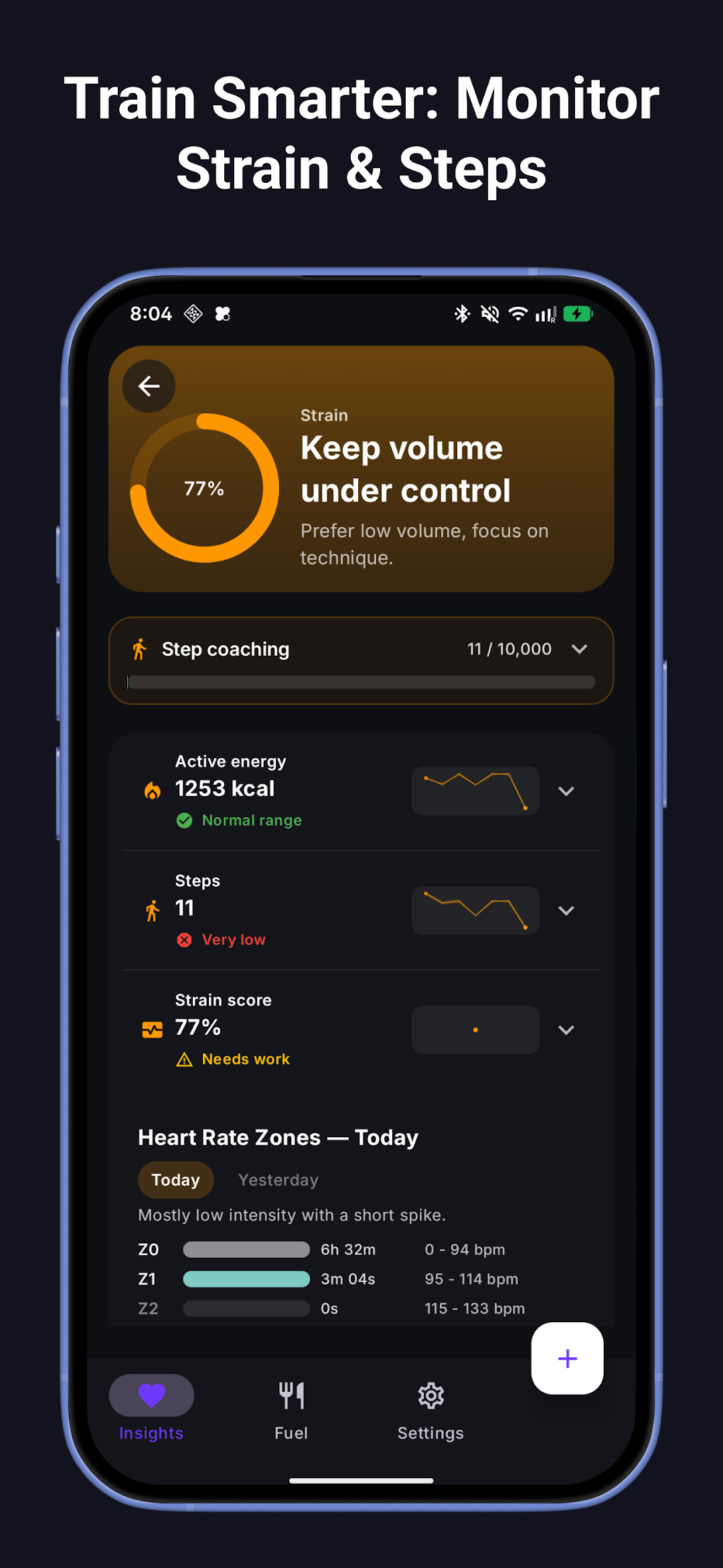
An integration is a route, not a blanket guarantee
On Android, one route looks like this:
Device ? its source app ? Health Connect ? Nutrinaut
Each arrow matters. A watch recording a measurement does not establish that its app shares that measurement with Health Connect. Health Connect containing a record does not establish that Nutrinaut has permission to read it.
Garmin can also have a separate account connection in Nutrinaut. That route should not be confused with granting Health Connect permissions. Our connections guide explains how to check the source and the route before assuming a device is compatible with a particular feature.
For a developer, this changes the meaning of “connected.” An authorization screen can complete successfully while a particular category still contains no usable records. A responsible interface has to make room for that condition.
For a user, there is a practical check: choose one observation you already know exists, such as a recorded night of sleep, and follow it through the source app, the bridge and the destination. That is more informative than refreshing a dashboard repeatedly.
The difficult parts hide behind ordinary labels
“Steps,” “sleep” and “HRV” look like simple fields until several sources start supplying them.
For example, a phone and a watch may both record the same walk. Adding every raw record can count overlapping activity twice. Google’s Health Connect aggregation documentation explains how source priority affects deduplication for supported Activity and Sleep data. The existence of that platform behavior does not prove that every app uses the right query for every field. Health Connect aggregation.
A similar issue appears in time. There is the time an observation happened, the time it arrived, and the time the screen refreshed. Refreshing a screen now does not turn an old sleep record into last night’s sleep.
Even HRV needs more than a label. In the Nutrinaut implementation reviewed for our documentation, Android requests RMSSD while the Apple Health reader requests SDNN. Both can be expressed in milliseconds; they are still different definitions. A neat cross-platform chart must not imply that they are interchangeable.
Those details influence the architecture of a useful app: preserve the source, preserve the date, preserve the definition, and distinguish missing information from a measured zero.
Tags supply context the sensor does not have
We wanted people to record something about the day as well as import its measurements.
A late meal, a stressful event, feeling unwell or a change in routine may matter to the person reading their history. Tags let them preserve those events with a time and relevant details. Nutrinaut can then consider that context alongside the observations available to its insight features.
There are limits to what that means. An unrecorded tag does not establish that an event did not happen. An event occurring before a different reading does not establish causation. A useful explanation should let someone see which observations support it and what information is absent.
This is a software design problem as much as an AI problem. The explanation inherits the quality of its input. A fluent paragraph cannot repair a missing record or identify an ingredient the camera could not see.
What the annual app price leaves out
An inexpensive app cannot create a sensor that the existing device does not contain. It cannot promise identical sampling, battery behavior or algorithms to a dedicated wearable. Nor does displaying a recovery score establish that the score matches another product’s score or has been clinically validated.
Someone who wants a dedicated band’s specific experience may reasonably choose that band and membership. Someone whose existing device already supplies the relevant observations may prefer software that helps them use those records. The meaningful comparison includes the equipment they already own, rather than pretending everyone starts from the same place.
Our price goal also creates work for us. We need the basic data route to be understandable, the insights to acknowledge their inputs, and the product to remain useful when some information is unavailable. Lower price alone cannot do those jobs.
The question I now use to judge the product
I no longer think the strongest promise is “the same as WHOOP for less.” I want us to answer a more specific question:
Can this person understand an observation from their own device, connect it to the context they recorded, and see the limits of the explanation?
That gives us concrete work to do. It also gives a prospective user a better basis for deciding whether Nutrinaut fits their phone, their equipment and their routine.
Disclosure and scope: I work on Nutrinaut. This is an account of our product direction and implementation lessons, not an independent comparison or a clinical validation study. Nutrinaut is not affiliated with Bevel, Athlytic or WHOOP. Features, compatibility and offers change; inspect the current app, source settings and purchase terms before paying.